
Top Surgery
I’m 62 years old, why take the risk?

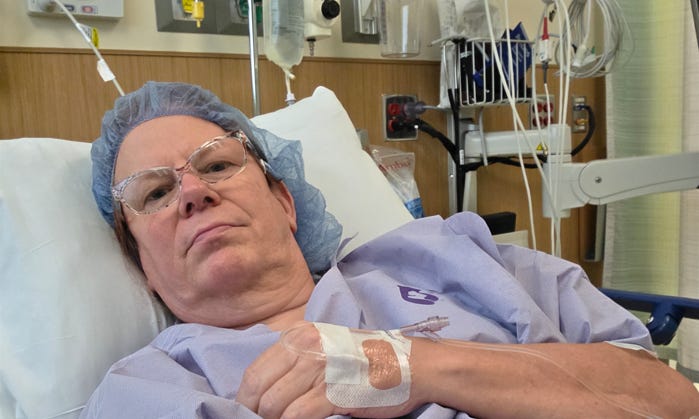
On Wednesday, I had breast augmentation - my latest round of gender confirmation surgery. But I’m not feeling as joyful as I did a couple of years ago.
Some of that is the climate: with all the anti-trans rhetoric circulating right now, it’s hard not to feel vulnerable. I’m also getting older, and aging brings new concerns and complications. Surgery is never without risk. Recovery is difficult. The more visible my physical changes become, the more likely I am to face harassment and discrimination. So why now?
Am I doing this because I fear the opportunity might be taken from me in the future? Because the longer I wait, the harder recovery gets? Or is it because this is something I need to do to fully love myself and my body?
In truth, all three of those questions shaped my decision.
I am afraid of losing insurance coverage for gender care, which is happening across states nationwide. It began with restrictions on care for kids and surgeries but is rapidly expanding to include people of all ages and every form of gender-affirming care. This hurts me deeply. I was 58 years old when I began my transition. Until I met a transgender woman, I didn’t understand that I was a transgender woman. I’m proud of who I am and sorry that I misunderstood myself for so many years. I hurt myself and the people I love by trying to be someone I wasn’t.
When I was younger, there were no standards of care. Hormones and surgeries were ad hoc: often under the table and prescribed or performed by doctors who weren’t members of the queer community and didn’t understand transgender care. Many doctors treated their patients with disdain. You found care, if you found it at all, through whisper networks and at significant risk.
Over the past two decades, that changed. Not because science suddenly discovered us, but because trans people insisted on being seen. Community advocacy, patient experience, and medical research came together to define real, evidence-based standards of care. Today, those standards - rooted in data and lived experience - are recognized by all major medical organizations and respected insurers. The regret rate for gender confirmation surgery is below 1%, which is far lower than most common surgeries and many major life decisions.
While you consider that, it’s crucial to know that suicide rates among gender non-conforming youth have increased by as much as 72% in states that have passed laws restricting care. LGBTQ+ youth are four times more likely to attempt suicide, with an LGBTQ+ kid attempting suicide every 45 seconds. Providing care saves lives, but some people are hellbent on taking care away. To those who want to see trans people erased, who work every day to strip us of care, dignity, and life: fuck you. We are not going anywhere. We survived your silence, your contempt, and your violence, and we will survive this too.
With all that in mind, I want to get surgery while it’s still legal, safe, and guided by standards of care.
I’m glad I’m not getting older, unlike…
Strike that.
I am getting older. And it weighs on my life decisions. Recovery from vaginoplasty took more than a year. For a long time, I couldn’t do the things I once took for granted. Breast augmentation is a less invasive surgery, but it will still take months before I’m back to full strength. I’ll lose muscle mass while healing, and rebuilding strength takes longer and gets harder with every passing year. Age increases the risk of complications, too. I feel pressured to move quickly: aging is not slowing down, and I want to spend as much time as I can enjoying who I am.
Is top surgery something I need to do to love myself and my body? Absolutely. I know it can be hard for people who don’t experience gender dysphoria to understand, but gender-affirming care changes lives. Hormones and vaginoplasty likely saved mine. The more I learned about what was possible, the more essential it became to live fully as myself: as Clara. I’ve written this before, but it bears repeating. There aren’t more transgender people now because we suddenly appeared. There are more of us visible now because medical care has made it possible to live as who we are.
I thought back to my gender dysphoria assessment from years ago. Buried in all the clinical language was a simple truth: “wants breasts.” Hormone replacement therapy is scientific magic. It redistributes fat, increases breast size, and brings profound physiological changes. But it can only go so far, especially since testosterone shaped my body for decades. I’m a trans woman, and I want a feminine figure. I want my outside to reflect my inner self. I want the world to see me for who I am.
In short: all three reasons - anger, aging, and self-care - shaped my decision. I’m afraid I’ll lose the opportunity to access gender confirmation surgery. I’m getting older, and I want to do this while I still can: to reduce the risk and to maximize the time I get to live as myself. And finally, I’m doing this for me. Pursuing gender-affirming care has changed my life in profound and beautiful ways. I can’t imagine stopping now.
I want to share an important note. The transgender umbrella is a big one. It includes countless variations of the human spirit, mind, and soul. Everyone’s path is different. Surgery is not a requirement of being transgender. Different people need different things. What’s right for me may not be right for someone else. What matters most is that we build understanding and appreciation for all the ways people show up in the world. That’s what diversity means.
(1) A systematic review of patient regret after surgery- A common phenomenon in many specialties but rare within gender-affirmation surgery. The American Journal of Surgery Volume 234, August 2024: https://www.sciencedirect.com/science/article/abs/pii/S0002961024002381#:~:
(2) More trans teens attempted suicide after states passed anti-trans laws, a study shows. Short Health News, National Public Radio, September 2024: https://www.npr.org/sections/shots-health-news/2024/09/25/nx-s1-5127347/more-trans-teens-attempted-suicide-after-states-passed-anti-trans-laws-a-study-shows
(3) Facts About Suicide Among LGBTQ+ Young People, The Trevor Project, December 2021: https://www.thetrevorproject.org/resources/article/facts-about-lgbtq-youth-suicide/
(4) Stone Butch Blues: https://www.lesliefeinberg.net/